


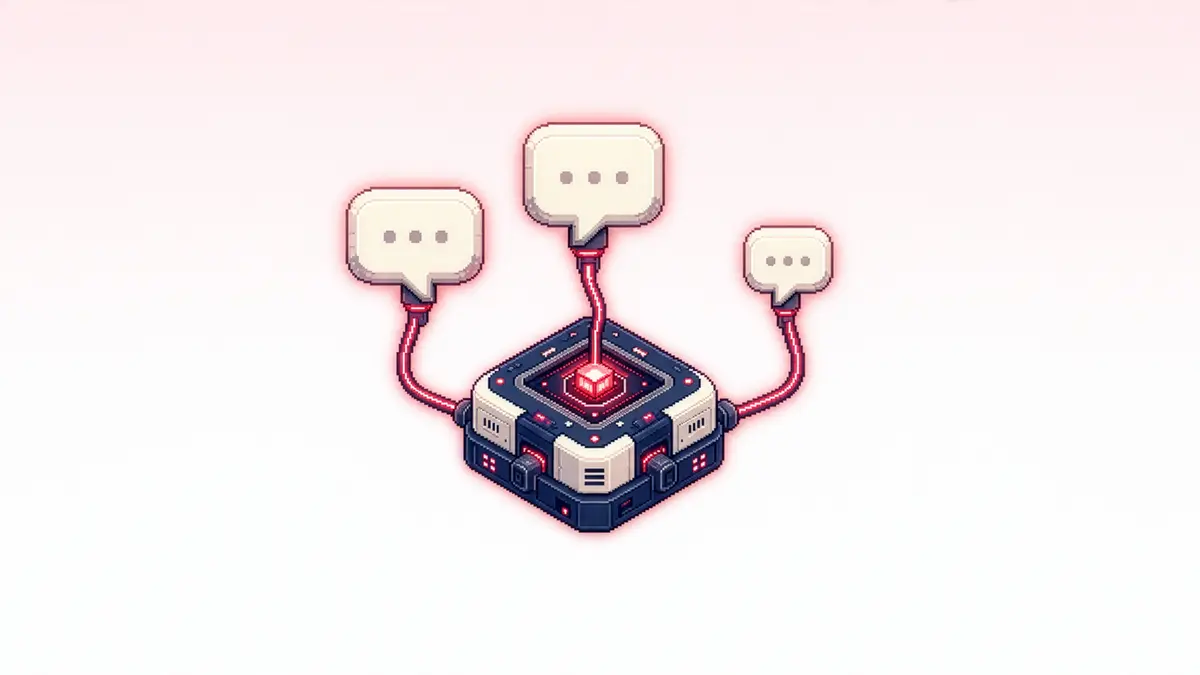
Four players meet in a lobby, form a party, and drop into matchmaking together. Matchmaking pulls them into a ten player match, fills out both teams with strangers, and splits the lobby into two sides. Halfway through, someone rage quits, and backfill slots in a replacement. When it ends, the original party lands back in the lobby, and one of them fires off a direct message to a player they just met.
Count the conversations that had to exist for that to work. Lobby chat. Party chat. Team chat. Match chat. A DM thread. For a few minutes, one player was a member of all of them at once, each with its own rules about who could see what and how long it lived.
Sending a string from one player to another is the easy part. A WebSocket connection and an afternoon will get you that. The hard part is deciding whether this player should be able to send this message to that player at this exact moment in the game, and keeping that answer correct while the player moves through lobbies, parties, matches, and teams that are all changing underneath them.
That is the real problem in-game chat solves, and it is why chat is not a feature you bolt on at the end. It is a routing, identity, membership, permission, and lifecycle problem that has to stay synchronized with the rest of your backend. This piece is about how to think through those relationships before you build, instead of discovering them one production incident at a time.
The Channels Are Not the Architecture
Most chat systems start the same way. Someone makes a list of channels, something like:
-
global
-
party
-
lobby
-
match
-
guild
Then they wire each one to a room in whatever messaging library they picked, and it works in a demo. The trouble starts later, when the channels drift out of sync with what is actually happening in the game. A player leaves a party but can still read party chat. A match ends but its channel lingers. Someone gets kicked from a session and keeps talking in it because nothing told the chat system to remove them.
The channels were never the hard part. The hard part is the question underneath them:
What game state creates the communication context, and what destroys it?
A channel is just a name. A communication context is a channel plus the answer to who belongs, why they belong, and when they stop belonging. Once you frame it that way, most chat contexts turn out to be derived from a state that already exists somewhere else in your backend.
Read the middle column again. Almost none of it is a chat state. Party membership belongs to your party system. Session membership belongs to your session system. Team assignment comes out of matchmaking. If chat maintains its own private copy of all of that, you now have two sources of truth for the same fact, and they will disagree. The interesting design work is deciding which system owns each fact and how chat reads it, not inventing a parallel membership system inside chat.
The Four Things Every Message Is Really About
Before going context by context, it helps to have a small vocabulary that works everywhere. Every chat message, in every game, is resolved through four questions.
-
Identity.
Who is the sender? Not their platform account, their game-level identity. A player might sign in from Steam today and PlayStation tomorrow and should be the same person in chat both times, carry the same block list, and answer to the same moderation history. Platform accounts are an input to identity, not the identity itself. -
Conversation.
What space does this message belong to? A party, a session, a team, a guild, a DM thread, a global topic. The conversation is the addressable thing a message is sent to. -
Membership.
Who currently has access to that conversation, and how did they get it? Membership can be requested (you asked to join a guild), inherited (you joined a party, so you are in party chat), persistent (a friendship), or temporary (a match). -
Permission.
What can each member actually do here? Send, receive, read history, invite, mute, remove others, moderate. Being a member is not the same as being allowed to talk. A spectator is a session member who probably should not post in team chat.
Keep these four in mind for the rest of the article. Every design question below is really one of them wearing a different costume.
Chat Membership Is Many-to-Many
Here is the assumption that quietly breaks most first attempts: developers model a player as being "in chat," as if chat were one room the player is either in or out of. Real players are never in one conversation. They are members of several at once, each with different permissions and different lifetimes.
During that opening scenario, one player was simultaneously in party chat (their four friends), lobby chat (everyone prepping for the match), team chat (their side of the match, the party plus the extra player matchmaking added), and match chat (all ten players), and they had a DM thread open the whole time. Five conversations, one player, five different answers to "who can read this."
Model this as a many-to-many relationship from the start. A player has many memberships. A conversation has many members. The membership itself is the thing that carries a role and a lifetime, not the player and not the conversation. Get that wrong and you will spend the rest of the project special-casing the player who is in a party and a match and a guild at the same time, which is to say, every player.
Party Chat: Let the Party Own It
Parties are the cleanest example of chat membership that should follow another system, so they are a good place to make the pattern concrete.
A reasonable party chat lifecycle looks like this: A player creates a party, and party chat comes into existence with it > They invite a friend > The friend accepts, joins the party, and gains chat membership as a consequence, not as a separate step. Another member leaves, and their chat membership goes away with their party membership. Eventually the party disbands and the conversation ends. At no point did anyone "join party chat." They joined the party, and chat followed.
That coupling is the whole point, and it is where the edge cases live.
-
Party leadership changes.
If the player who created the party goes offline, the party should not evaporate, and neither should its chat. Ownership of the conversation should not depend on the original creator staying connected. This sounds obvious until you find a system that ties the chat room's existence to the socket of whoever opened it. -
A member disconnects.
Does party membership survive a dropped connection? Most games say yes for some grace window, because players lose Wi-Fi mid-session all the time. If party membership survives, party chat membership almost certainly should too, so the player can rejoin and see what they missed instead of coming back to an empty room. -
The party enters matchmaking.
This is the one people get wrong. Party chat should not care that the players are now looking at a matchmaking screen instead of the party screen. The party still exists, so its chat still exists. If your chat membership is tied to the current UI screen rather than to the party, entering matchmaking will silently drop everyone out of party chat at worst possible moment, right when they're coordinating. -
The party splits after a match.
Two players stay together, two leave. What happens to the conversation? There is no universal answer here. You can end it, preserve the history for the members who remain, let the remaining pair continue in the same thread, or promote it into a longer-lived relationship like a friend group. The mistake is not picking the "wrong" option. The mistake is not deciding, and letting the behavior fall out of whatever your library happens to do by default.
Lobby Chat Is Not Party Chat
Games use "lobby" and "party" almost interchangeably in casual speech, which is fine until you have to implement both, at which point the difference matters a lot.
-
A party is a relatively persistent group that chose to play together. It is intentional. You invited these people.
-
A lobby is a temporary, pre-session grouping the game assembled. A single lobby might contain several parties, a handful of solo players, both teams that are about to fight each other, and a few spectators. Nobody in a lobby necessarily chose anybody else.
Those are different communication requirements, not different labels for the same thing. Lobby chat is "everyone in this pre-game space can talk," which often means opponents can taunt each other before the match, and which you might want to disable entirely for ranked play. Party chat is "only my group," and it needs to stay private even though the party is sitting inside a shared lobby. Team chat is "the people matchmaking assigned to my side," a membership that did not exist until a few seconds ago.
A player standing in that lobby is in all three at once. That is the many-to-many picture again, and it is exactly why "which channel is the player in" is the wrong question. They are in all of them, with different permissions in each.
Session Chat: Let Session State Drive Access
Now go one level deeper into multiplayer, where the timing gets genuinely tricky.
A game session gets created when matchmaking finds a match. Players are assigned to it. Somewhere in here a dedicated server gets allocated, the players connect to it, and the match begins. Session chat needs to exist somewhere along that path. The question is where.
You have a few candidate moments to grant session chat access, and each one is a real decision:
-
At match creation, before anyone connects.
Players can coordinate early, but you are granting chat to a session that might still fall apart if someone fails to connect. -
At session join, once the player is formally a member.
Cleaner, but "member" and "connected to the game server" are not the same thing yet. -
At server connection, when the player is actually in the game.
Safe, but there is a gap where members exist and cannot talk. -
At gameplay readiness, once the match is truly live.
Safest, latest, and it means no pre-game coordination.
There is no correct answer independent of your game. A tactical shooter wants team chat live during the buy phase. A quick-match party game might not need session chat until the round starts. Pick deliberately based on when players actually need to coordinate, and know why you picked it.
Then handle the cases that make session chat hard:
-
Backfill.
A player dropping into a match already in progress, common in anything with a shared world like Sea of Thieves or any battle royale that refills squads, has to get the right memberships automatically on the way in. Session chat, and their team's chat if they were slotted onto a team. If backfill is a separate code path that forgets to grant chat, those players show up mute. -
Reconnect.
A player who dropped may still be a session member for a grace period. If they are still a member, their chat membership should still be intact when they come back. More on reconnect below, because it is the best stress test you have. -
Spectators.
They belong to the session but usually should not talk in team or match chat. This is a permission distinction, not a membership one. They are members with read access and no send permission, which is exactly why you want permission modeled separately from membership. -
Teams.
Inside one session a player can be in session chat and team chat at the same time, on top of the party chat they carried in from before the match. Three live conversations layered over each other, all derived from different systems: the party system, session system, and the matchmaking result.
If you want the deeper version of how matchmaking and sessions produce these memberships in the first place, we wrote a whole piece on real-time multiplayer and matchmaking that this sits on top of.
Direct Messages Are a Different Architecture
Everything so far has been session-shaped: a conversation that exists because players are in the same game context right now, and disappears when that context does. Direct messages are the opposite, and treating them like session chat is a common and painful mistake.
DMs are persistent and identity-driven. The conversation is not created by a shared party or match. It is created by a relationship between two identities, and it outlives any particular game session by design. The question a session chat asks is "are these two players in the same game context right now?" The question a DM asks is completely different: Is this player allowed to contact this other player at all?
That single question drags in most of your social and safety systems. Player discovery, friend requests and the request-accept flow, cross-platform identity so a friend is the same friend across devices, blocking, online and offline delivery, unread state, message history, what happens to a thread when one account gets deleted, and moderation. None of that is part of session chat, and all of it is part of DMs.
So DMs need a permission model that session chat does not. Who can message a given player? The common options, roughly from open to closed:
-
anyone
-
friends only
-
friends of friends
-
same guild
-
players you recently played with
-
nobody
This is where player privacy preferences stop being a settings-screen nicety and become part of the architecture. "Recently played with" means your DM system has to read recent-session history. "Friends of friends" means it has to walk the social graph. Those are real backend queries that have to run before a message is allowed through, and they are the reason DMs are their own system with its own rules rather than another kind of room. Cross-platform identity in particular is its own hard problem, and it is worth understanding on its own before you lean on it for DMs. We went deep on that in the cross-platform play write-up.
What Actually Happens After Send
Zoom in on a single message. A player types something and hits send. Between that keypress and the words appearing on someone else's screen, a lot has to happen in order, and every stage is a place where the message can be legitimately stopped.
Let's walk it stage by stage:
-
Authentication.
Verify the sender is who they claim to be. This is a token check, not a chat-specific problem, but chat has to actually do it rather than trusting a player ID. -
Membership.
Confirm this player is actually a member of the conversation they are trying to post to. Not "did the client say they are a member," which is a different and dangerous thing. Confirm it against the system that owns that membership. -
Authorization.
Membership is not permission. Confirm the sender's current role in this conversation allows sending. A muted player is a member who cannot send right now. A spectator is a member with read-only access. -
Moderation and filtering.
Run the message through whatever profanity filtering, blocked-phrase, spam, link, and malicious-pattern checks you have. The architectural point is only that the hook belongs here, in the pipeline, not bolted on the client where it can be bypassed. -
Fan-out.
Figure out who actually receives this message. This is where block relationships get applied and where, at scale, things get expensive, which we will come back to. -
Delivery.
Push the message to the online recipients. -
Persistence.
If this conversation keeps history, store the message appropriately. Not every conversation should, which is its own section below. -
Notification.
Surface unread state or push a notification to recipients who are offline or not currently looking at the conversation.
You do not have to build all eight stages elaborately on day one. But you do have to know they exist, because the ones teams skip early, membership and authorization especially, are exactly the ones that turn into security incidents later.
The Server Decides Who Can Talk to Whom
Notice that the two most important stages in that pipeline, membership and authorization, are both the server answering a question the client is not allowed to answer for itself. This is the rule that separates a chat system that survives contact with real players from one that gets exploited in week one: the backend decides who can talk to whom, and it never takes the client's word for it.
A modified client will lie. It will claim to be a member of a party it was never invited to, try to post into the enemy team's channel, attempt to read a session conversation from a match it already left, or spoof another player's identity to send messages to them. If your permission check is "the client said it is allowed," all of those work.
The fix is not complicated to describe. When a message comes in, the backend resolves membership and permission against the authoritative systems, the ones that actually own party and session state, rather than against anything in the request:
onMessage(request):
    sender = authenticate(request.token) # not request.playerId
    conv = lookupConversation(request.convId)
    member = membershipStore.get(conv, sender) # authoritative party/session state
    if member is null: reject("not a member")
    if not member.canSend(): reject("no send permission")
    if isBlocked(conv, sender): handlePerBlockRules()
    ...
The trick is that membershipStore is not a copy chat keeps for itself. It is the same authoritative party and session state the rest of the game runs on. This is the concrete reason chat needs to be integrated with your backend rather than living beside it as an isolated service. A chat system that cannot cheaply ask "is this player really in this session right now" cannot enforce anything, and will trust the client by default because it has nothing else to trust.
Blocking Has to Work Across the Whole Graph
Blocking sounds like a one-liner. Player A blocks Player B, so hide B's messages from A. Build it that way and it will be wrong in about six different places.
If A blocks B, work through what should actually happen. Can B still DM A? Probably not. Can B still see A in their party, or send party messages A receives? Can B taunt A in a lobby chat? Speak in the same team chat during a match matchmaking put them both in? Land in a match with A through matchmaking at all? Post where A will see it in guild chat?
The answers differ by game, and that is fine. A competitive game might let a blocked player still appear in the same match, because you cannot let players dodge matchmaking by blocking every strong opponent, but suppress their chat entirely. A social game might refuse to place blocked players together at all. Those are legitimate design differences.
What is not negotiable is where the block gets enforced. If blocking is a UI-level "hide these messages" on the client, then the messages are still being sent, still being delivered, and a modified client just ignores the hide. Blocking has to be recognized by the backend communication layer, applied during fan-out, so B's message never reaches A regardless of which context they share or what client B is running.
While you are here, keep four related tools distinct, because they solve different problems and players and support staff will conflate them constantly:
-
Mute is one player choosing not to hear another, usually scoped and often temporary. It is a personal preference.
-
Block is a mutual communication cut across contexts, and it is persistent.
-
Friend removal changes a social relationship. It might change DM permissions as a side effect, but it is not a safety action.
-
Sanctions are the game punishing a player: a chat ban, a suspension, something applied by moderation or automated systems, not by another player.
They feel similar in the UI. They are different rows in different systems, and collapsing them into one "ignore" flag is a decision you will regret the first time a moderation case needs to tell them apart.
Conversation and Message Lifetime Aren't Same
A conversation ending and its messages disappearing are two separate events, and good chat architecture keeps them separate.
Different conversation types want different persistence. Party chat can be temporary, gone when the party disbands. Match chat is often short-lived, useful during the match and irrelevant after. Guild chat is usually persistent, because a guild is a persistent community. DMs are typically persistent, because a conversation you can never scroll back through barely counts as a conversation. But "the players can no longer see this conversation" and "these messages no longer exist" are different lines on the timeline.
The clearest example is a match conversation. When the match ends, players lose access. From their side, the conversation is gone. But the messages might be retained for a while longer, invisible to players, available to moderation, in case someone files a report an hour later about harassment during that match. Conversation lifetime, the player-facing thing, ended at the match. Message lifetime, the moderation-facing thing, runs longer and then expires.
Decide both, per conversation type. How much history exists, how much gets replayed on reconnect, how unread state is tracked, where messages are stored, what is kept as moderation evidence and for how long, and how deletion and player privacy requests are honored. The detailed retention and privacy policy is its own topic but the architectural decision you cannot skip is simply acknowledging that these are two different clocks, not one.
Reconnects Are Where Bad Architectures Crack
If you want to know whether your chat design is actually sound, trace a reconnect through it. Nothing exposes a chat system built on its own private membership state faster.
A player loses connection during a match. Their phone switched towers, their Wi-Fi hiccuped, the usual. Thirty seconds later they are back. At that moment your system has to answer a pile of questions at once:
Are they still a member of the session? Still on the same team? Should their party chat still be intact? What messages did they miss while they were gone? Should any of that history be replayed? Were they removed from anything while disconnected? Did their permissions change, say, from player to spectator?
If chat membership is derived from an authoritative game state, reconnect is almost easy. You ask the session system whether they are still a member, the matchmaking result which team they are on, the party system whether the party still exists, and you rebuild their chat memberships from those answers. The authoritative systems already tracked all of this, because they had to for the game itself to work.
If chat maintains its own independent membership instead, reconnect becomes a reconciliation problem. Chat thinks the player is in these conversations, the session system thinks they are in those, and now you are writing code to merge two copies of state that drifted apart during a network blip. That code is where the bugs live: players who reconnect into ghost conversations, players locked out of the match chat they are clearly still playing in, permissions that reset to the wrong thing.
The lesson is the thesis of the whole piece, seen from the angle that makes it undeniable: chat that follows authoritative state recovers cleanly, and chat that hoards its own state does not.
What Changes at Scale
Everything above is about correctness with a handful of players. It is worth knowing which of the decisions become load-bearing when the player count climbs, because the architecture you pick now decides whether those problems stay contained later.
As concurrency grows, a few things start to hurt. Global and community rooms become hot partitions, a single conversation that thousands of players read from and write to at once. Fan-out gets expensive, because delivering one message to a large room is one write times a very large number of recipients. Presence churn increases as more players connect, disconnect, and move between contexts every second. Reconnect storms happen when a region blips and thousands of players all reconnect together, each triggering the membership re-derivation from the last section at the same instant. History writes pile up. Moderation workload grows with raw message volume. And rate limits stop being optional.
You do not solve those here. The point is narrower: an architecture where chat derives context from identity and game state can isolate these problems, throttling a hot global room without touching party chat, sharding by conversation, applying back-pressure per context. An architecture where everything is one undifferentiated firehose cannot, because it has no seams to cut along.
Moderation Is an Architecture Decision
The last thing that has to be designed in from the start, even though most of its work happens later, is moderation. Not the policy, the plumbing.
A moderation system, whether human review, automated filtering, or both, can only act on the context the chat system captured at the time. If a report comes in three days after the fact, the questions the moderator needs answered are: who sent it, who received it, in what conversation, at what time, what was said around it, what party or session were these players in, were there prior reports, was there a block relationship, and had this sender been actioned before.
If chat only ever stored "message text, sender, timestamp," none of the relationship context exists anymore, and the investigation stalls. The expensive version of this mistake is discovering it after launch, when the abuse is already happening and the data you needed to investigate it was never captured. Retrofitting context capture into a live chat system, while it is under load and under scrutiny, is a bad week.
Capture enough context to reconstruct a conversation and its surroundings, decide the retention window deliberately (that two-clocks point from earlier), and treat the moderation hook in the pipeline as a first-class stage rather than an afterthought. The strategy of what to do with all that, the actual chat moderation design and the harder problem of stopping deliberate abuse at scale, are their own pieces. This is just the reminder to leave the door open for them.
A Reference Architecture
Put it all together and a shape falls out. It is not a product diagram and it is not the only valid layout. It is the dependency order that keeps chat honest.
Read it top to bottom and the principle is right there in the arrows. Identity is the root. The social graph and the multiplayer state are derived from and attached to identity. Chat membership is derived from those two, not invented alongside them. Conversations are views over membership. The pipeline is the one place permission and filtering get enforced. Delivery and history are outputs, and moderation reads from history. Nothing in that chain asks chat to be the source of truth for anything except the messages themselves. That is the whole idea:
Chat derives its context from identity and game state instead of becoming its own isolated universe.
Where This Maps to a Real Backend
Everything so far is vendor-neutral on purpose. You can build this on your own infrastructure, and plenty of studios do. The reason it is worth naming a concrete platform at all is that the design leans hard on one thing being true: chat has to be able to cheaply and authoritatively ask about identity, parties, and sessions. When those systems live in the same backend as chat, the "derive, don't duplicate" rule stops being aspirational and starts being the path of least resistance.
AccelByte Gaming Services is a useful concrete example because it puts those systems in one place. Its chat model maps directly onto the contexts above: personal chat between players (the identity-driven DM case), party chat that follows party membership, and session chat gated by session membership. Because parties and sessions are themselves AGS services, chat is reading the same authoritative membership the rest of the game runs on rather than a private copy, which is exactly the property the reconnect and server-authority sections depend on.
The identity piece is handled by AGS identity and access management, which gives a player one game-level account across the platforms they sign in from, so block lists, sanctions, and DM permissions attach to the person rather than to a Steam or console account. On the safety side, AGS chat ships a configurable profanity filter and chat reporting and moderation workflows, which is the pipeline moderation hook and the context capture from the last two sections, available rather than something you retrofit. And because AccelByte also handles matchmaking and multiplayer sessions, the team and session memberships that create match chat come from the same system that ran the match.
Voice is worth a one-line note, since games increasingly need both. Text and voice can share the same session and social context, who is in this party, who is on this team, even when the underlying moderation pipelines for audio and text are different problems. The membership question is the same; the enforcement differs.
None of that is the point of the article, and if you are building your own stack the principles hold anyways. The reason it fits here is narrow and architectural: communication state should be able to follow the multiplayer and social relationships the game already defines, and a backend that owns identity, friends, parties, sessions, matchmaking, and chat together makes that following the default instead of a project.
The Checklist You Can Actually Use
If you take one thing from this, make it this list. Before you write chat code, you should be able to answer every one of these. If you cannot, that is your design work, not your implementation work.
Identity
-
What identity represents a player in chat, and is it a game-level account rather than a platform account?
-
Can one player have multiple platform identities that resolve to the same person?
Conversations
-
Which conversation types exist in your game?
-
What game state creates each one, and what destroys it?
Membership
-
Which system owns membership for each conversation type?
-
Is it derived from parties and sessions, or maintained separately (and if separately, why)?
Permissions
-
Who can send, and who can only read?
-
Who can read history? Are spectators and moderators distinct roles?
Lifecycle
-
When is each conversation created, and when does it end?
-
What happens to membership on reconnect?
Messages
-
Which conversations persist, and for how long?
-
How much history gets replayed when a player returns?
Safety
-
How do block and mute relationships affect delivery, and are they enforced on the server?
-
What context is captured for moderation, and how long is it retained?
Operations
-
Can support reconstruct a conversation to investigate a report?
-
Can a developer trace why a specific message was or was not delivered?
You will not have final answers to all of these on day one, and some will change. But every one you leave unanswered is a decision your chat library is going to make for you to reverse-engineer later.
The Real Takeaway
You probably came here because you need to add chat to a game. The useful realization is that "chat" was never the task. The task is defining how communication relates to identity, parties, matchmaking, sessions, blocking, reconnects, and moderation, and then letting messages ride on top of those relationships. Get that mapping right and chat becomes almost boring, in the good way: memberships follow state, the server enforces the rules, reconnects, heals themselves, and moderation has what it needs. Get it wrong and you will spend launch week explaining why players can read channels they left and can't read the one they're standing in. Map the flows before you wire the messages.
FAQ
You can build it yourself, and many studios do. The catch is that chat depends on cheap, authoritative access to identity, parties, and sessions, so building chat well usually means building or integrating those systems too. Platforms like AccelByte Gaming Services package identity, friends, parties, sessions, matchmaking, and chat together, which makes the "derive membership from game state" pattern the default rather than extra integration work. If you are weighing options, it helps to compare how different game backend providers handle the social and multiplayer layer, because that is where chat gets its context.
Featured Blog Posts



Bring your first player online today.
Get started for free, and scale as your game grows.