



Open a fitness app, a language app, a creator platform or a community app and look past the UI. There's a login screen. A profile. Some saved state that's supposed to follow you when you get a new phone. A friends list. A streak counter. A badge for showing up seven days in a row. Maybe a leaderboard. And more and more often, a currency: coins, gems, points, credits. Something you earn and spend.
Every one of those is a backend system. And every one of them is something online games have been building, breaking and rebuilding at scale for well over a decade.
That overlap is what this post is about. Games didn't invent accounts or profiles, but they're the kind of software that has had to run all of these systems at once, for millions of people, with a meaningful slice of those people actively trying to break them. What came out of that is a set of backend services that are a lot more finished than the general-purpose tools most app teams start with. Most of them don't care whether the thing calling them is a game.
There's a timing angle too. A small team, or one person with an AI coding assistant, can get a working app in front of users faster than ever. What that speed gets you is the app. The part underneath (accounts that have to stay secure, balances that can't drift, data that has to survive a phone upgrade) still has to be designed and run by somebody, and it's usually the part that gets expensive later.
The Backend Problems Apps Share with Games
It helps to separate two kinds of backend.
A backend-as-a-service like Firebase or Supabase gives you primitives: auth, a database, file storage, serverless functions. They're very good at it, and for plenty of apps that's everything you need.
A game backend like AccelByte Gaming Services (AGS) gives you finished systems built on those kinds of primitives: a wallet with a transaction ledger, a store that grants entitlements, a leaderboard that resets every Monday, a challenge set that rotates daily. You don't design the data model, just configure systems.
That difference doesn't matter until your app needs one of those finished systems. Then it matters a lot, because primitives give you everything you need to build a wallet and nothing that stops you from building it wrong. Here's what the overlap looks like, building block by building block.
Accounts and Login, Including the Auth You Already Have
Games deal with identity across platforms: the same person on Steam, PlayStation and a phone, who expects their progress to follow them everywhere. Apps have the same problem with different logos. Email and password, Google, Apple, Facebook, and account linking so the person who signed up with email and later taps "Continue with Google" doesn't end up with two accounts and a support ticket.
The part that matters most for an existing app: you shouldn't have to migrate your users to add a feature.
AGS supports email login, social providers, account linking and two-factor, and it can sit alongside an identity provider you already run through OpenID Connect instead of replacing it.
User Data that Follows People Across Devices
Games call it cloud save. App users call it "why did my settings reset when I got a new phone." Same problem. You need per-user records the client can read and write, and records only the server can write, so nobody edits their own unlock status or coin balance by poking at local storage. We went deep on this one in our piece on cloud saves and player data, and almost all of it applies to apps.
Friends, Groups and Chat
Friend lists, follow requests, groups (crews, clubs, squads, study groups, whatever your app calls them) and chat inside those groups. Games need this for parties and guilds. A running app needs it for clubs. A learning app needs it for cohorts. The data model is the same.
Progression: Challenges, Achievements, Stats and Leaderboards
This is where most "add game features to our app" projects actually live, and there's more system here than it looks.
A streak is a statistic with a reset cycle. A badge is an achievement that unlocks when a stat crosses a threshold. A weekly leaderboard is a ranked stat that resets on a schedule and has to handle ties and people submitting impossible numbers. A daily challenge is a set of goals that rotates, tracks progress per user, and pays out a reward on completion.
Want users to earn a badge for five workouts in a week? That's a stat on a weekly cycle with an achievement on top. Want a monthly board for your language app's most consistent learners? That's a leaderboard tied to a stat cycle. With a game backend you're configuring these, not writing them. AGS has statistics, achievements, leaderboards and a challenge service that rotates goals on a schedule.
Virtual Currency, Wallets and an In-App Store
Coins earned, coins spent, things granted. Underneath that sentence: a currency definition, a wallet per user, a ledger of every credit and debit, a catalog of items, entitlements that record what each person owns, and redemption codes if you're handing out vouchers. Plus real-money payment integrations if you want to sell currency too.
Games learned the hard way that "just add a balance field to the user record" is how you end up with negative coins and a very long week for support. More on that below.
Running It Without a Deploy
A lot of what makes these features work is operational, not technical. Marketing wants a double-coin weekend. Someone wants to swap the store items for a holiday drop. The challenge set needs new goals. In games this is live ops, and the tooling assumes non-engineers will be doing it. In AGS that happens in the Admin Portal: store items, currencies, challenges and rotations are all configured there, not codebase.
Custom Logic for the Parts that Don't Fit
No finished system matches every app. A skate challenge isn't a game quest, and a fitness streak might need rules no one else has. AccelByte Extend lets you write your own backend logic in Go, C#, Java or Python, hosted by AccelByte. You can override how a service behaves, react to events like a login or a completed purchase, or add your own endpoints, without running servers for it yourself.
Why "Just Build It" Costs More than It Looks
Take the most common version of this: users earn coins by doing something in your app and spend them on a reward. On a whiteboard that's a number on the user record and a button. Let's walk through what actually happens.
A user completes a challenge and earns 50 coins. You increment a field. Fine. Then they tap "redeem" on two devices within the same second. Both requests read a balance of 100, both subtract 80, and they've just spent 160 coins they never had. So you wrap it in a transaction. A week later the support gets a ticket: "my coins disappeared." You can't answer it, because you stored a balance, not a history. So you build a ledger, every credit and debit as its own record, and derive the balance from that. Then the vouchers: a brand partner sends you 500 codes. Each has to go out exactly once, never twice, never to someone whose payment failed, and you need to know when the pool is running low. Then somebody writes a script that completes your challenge 400 times an hour, so now you need server-side rules for what counts as a completion. Then marketing asks for a double-coins weekend, which is a code change and a release through both app stores.
None of those steps is hard on its own. Together they're months of backend work, and then they're yours to maintain, reconcile and be on call for. Firebase and Supabase give you the tools to do all of it properly (Firestore transactions and Postgres constraints are real answers to the double-spend problem). What they don't give you is the ledger design, the entitlement model, the code pool or the admin tools.
That's the part you'd be building.
Where AccelByte Fits, and What You'd Ignore
This is the class of problem AccelByte Gaming Services is built for, so it's a useful concrete example of how the pieces fit. AGS is a modular game backend: you turn on the services you need and call them over API from your app. You keep your existing stack. You don't have to think about the rest.
It's just as useful to know what you'd skip. A big part of AGS exists for real-time multiplayer: matchmaking, game sessions, and dedicated server hosting through AccelByte Multiplayer Servers (AMS). Unless your app runs live, real-time sessions between users, none of that applies to you.
One honest cost is that the vocabulary is game-flavored all the way down. The docs say "player," "game namespace," "game client." You'll translate as you go. It's a small tax, but it's real, and it's worth knowing.
A Real Example: How CityLegends Uses AccelByte
CityLegends is a community app for skaters, BMX riders, scooter riders and parkour athletes, built by a team in Eindhoven in the Netherlands. People find and share spots, post clips, go head to head in 1v1 battles, enter challenges and tournaments, and earn points and achievements along the way. It isn't a game. It does have a lot of game-shaped parts.
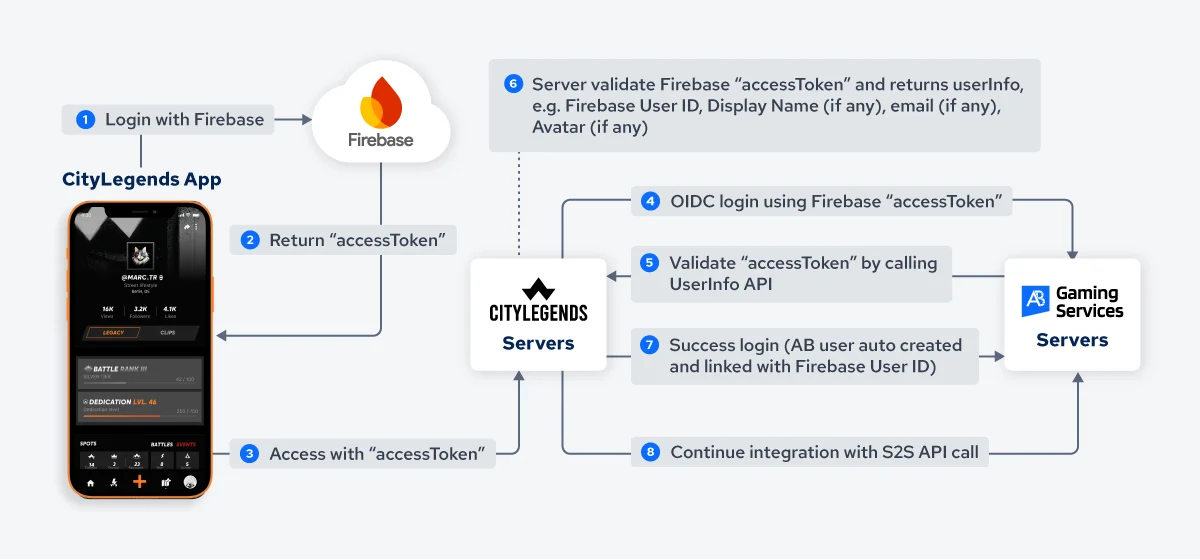
The problem they hit is the one from the worked example above. Users were earning coins, and coins you can't spend stop meaning much. CityLegends wanted a shop where people could trade coins for brand vouchers and CityLegends merch. That meant virtual currency, a wallet per user, a record of every transaction, a product catalog, order handling and a way to deliver voucher codes. All of it had to attach to accounts that already existed, because the app already ran on Google Firebase for login. Rebuilding login to add a shop was never on the table.
Here's how it came together.
-
Accounts first.
The first job was connecting AGS accounts to CityLegends' existing Firebase accounts. Not a migration: users kept logging in the way they always had, and AGS accounts sit alongside Firebase. Nothing else could start until this worked. -
The shop on AGS commerce.
With identity in place, CityLegends built the shop on AGS virtual currency, wallets and the store. Their developers use the APIs for product configuration, order processing and key distribution. -
Marketing runs it.
The marketing team uses the same backend to run promotions and track transactions. That's the live-ops point from earlier, in practice: the people running the shop aren't waiting on a release to change it. -
Challenges, reshaped.
CityLegends is extending the AGS challenge service to run daily challenges that pay out coins on completion [CONFIRM: live or still in progress]. This is the part that shows the tradeoff honestly. A game challenge and a skate challenge aren't the same thing, so this is less "switch on a feature" and more "take a flexible service and bend it to fit."
 The result: a fully working shop in three months. It's three months to integrate and ship on top of a currency, wallet and store that already existed. It isn't three months to build all of that from scratch, and the integration was real developer work. The team estimated the in-house build at around six months before they went this route.
You can read the full story here.
When This Is a Good Fit, and When It Isn't
A game backend in a non-game app makes sense when:
-
You need several of these building blocks, not one.
If all you need is login, you're overbuying. -
The systems you need have to be correct.
Currency, ownership and redemption are where a finished system saves you the most, because mistakes there cost real money and real trust. -
People who aren't engineers need to run things day to day.
Promos, store changes and new challenges shouldn't be tickets for your dev team. -
You have developers who can integrate APIs.
This isn't no-code. CityLegends needed real development work to connect accounts and wire up the store. -
You want to keep your existing stack.
Your auth and your database stay where they are.
It's probably not the right call when:
-
You need a database, auth and file storage, and that's it.
Firebase or Supabase will be simpler, cheaper and more general. Use them. -
Your app is web-first and depends on specific social login flows.
Check provider coverage before you commit. Some web login integrations are only available on Private Cloud today. -
You're looking for a drag-and-drop tool.
You'll be calling APIs and configuring services, not clicking together a shop.
What It Costs and How to Start
AGS pricing is based on daily peak concurrent users: the highest number of users hitting AGS APIs at the same moment each day. The docs say "players," but for your app that just means users. The public cloud is free for up to 30 peak concurrent users with the full platform, which is enough to build and test an entire integration. Past that, you pay based on your daily peak. The pricing page has the details, and we did the math for a few real scenarios in what AccelByte actually costs.
For a lot of non-game apps, concurrency looks different from a game's. Someone checking a streak or redeeming a voucher is on the API for seconds, not a 40-minute session. If your usage pattern doesn't look like a game's, talk to us and we'll scope it with you. If you want the broader version of this idea, with more examples of what apps are building, it's all on the Beyond Games page.
A lot of the backend your app is about to build already exists. The real question is whether building your own wallet, ledger and leaderboard system is the best use of your next few months. Pick the feature on your roadmap that's been sitting there because the backend looked heavy. Start there.
Plug In What Your App Needs
If your roadmap has accounts, saved data, social, progression or a store on it, you don't have to build those systems from scratch. AccelByte Gaming Services is free on public cloud up to 30 concurrent users, with the full platform and every backend service, so you can wire one feature into your app and see how it fits. Or talk to us first if you want help figuring out which pieces your app actually needs.
You're almost signed up!
Verify your account by following the instructions sent to .
If you still haven't received an email, please check your spam folder.
Featured Blog Posts
Featured Customer Stories


Bring your first player online today.
Get started for free, and scale as your game grows.