


Integrating a game backend takes real engineering time. Before writing a single line of game logic, someone has to read through API documentation, understand how services connect, and figure out what each endpoint actually expects. For a modern backend covering identity, matchmaking, economy, leaderboards, cloud save, and sessions, that research phase alone can run into weeks. Add custom backend logic on top and the work goes deeper.
AI coding assistants like Cursor, Claude, Gemini or Codex help at the edges but most developers have run into the same wall: point the AI at backend work and it starts guessing. It doesn't know your API's real endpoint paths, your SDK's type definitions, or how your services connect. So it generates something that looks close enough to compile but fails when you actually run it.
The fix is context. That's what the AccelByte MCP servers provide.
The Gap No Other Game Backend Platform Has Filled
When an AI coding assistant works on backend code without accurate context, the results are predictable:
-
It invents endpoint paths that don't exist in your API
-
It uses parameter names that don't match the real schema
-
It generates code that compiles but sends the wrong payload to the service
-
Wrong assumptions in one layer create bugs that are hard to trace back
What MCP Servers Are, Briefly
MCP (Model Context Protocol) is an open standard that lets AI coding assistants connect to external tools and live data sources. Instead of working from general training data, an AI assistant with an MCP server can query real information — your actual API specs, your SDK's function signatures, your service structure — and generate code based on that. The model stops guessing and starts using real context.
That changes what's possible for backend development. If you can connect an AI coding assistant to accurate, live knowledge of your backend's API surface and SDK structure, it can write production-ready code for your actual environment.
That's exactly what AccelByte has done by shipping two MCP servers:
2
Content-Type: application/json
2
Content-Type: application/json
-
One MCP server for core AccelByte Gaming Services (AGS) API layer
AccelByte Gaming Services (AGS) is our modular backend platform for multiplayer and online games. It covers the backend services most games need: player identity, matchmaking, economy, leaderboards, cloud save, chat, season pass, and server orchestration.
AGS API MCP Server connects your AI assistant directly to AGS APIs. From inside your IDE, it can search available endpoints, pull up the full schema for any operation, check required parameters and auth requirements, and make actual API calls against your real environment. Works with Cursor, VS Code Copilot, Claude, Gemini CLI, and anything that supports MCP.
-
Another MCP server for AccelByte Extend, a custom logic framework.
Extend is AccelByte's custom logic framework. It lets studios run game-specific backend logic like event handlers, service overrides, custom APIs and more in the language they already use (Go, C#, Java, Python), without building or hosting the infrastructure themselves.
Read this blog to understand what Extend makes possible and when it's the right tool for your game.
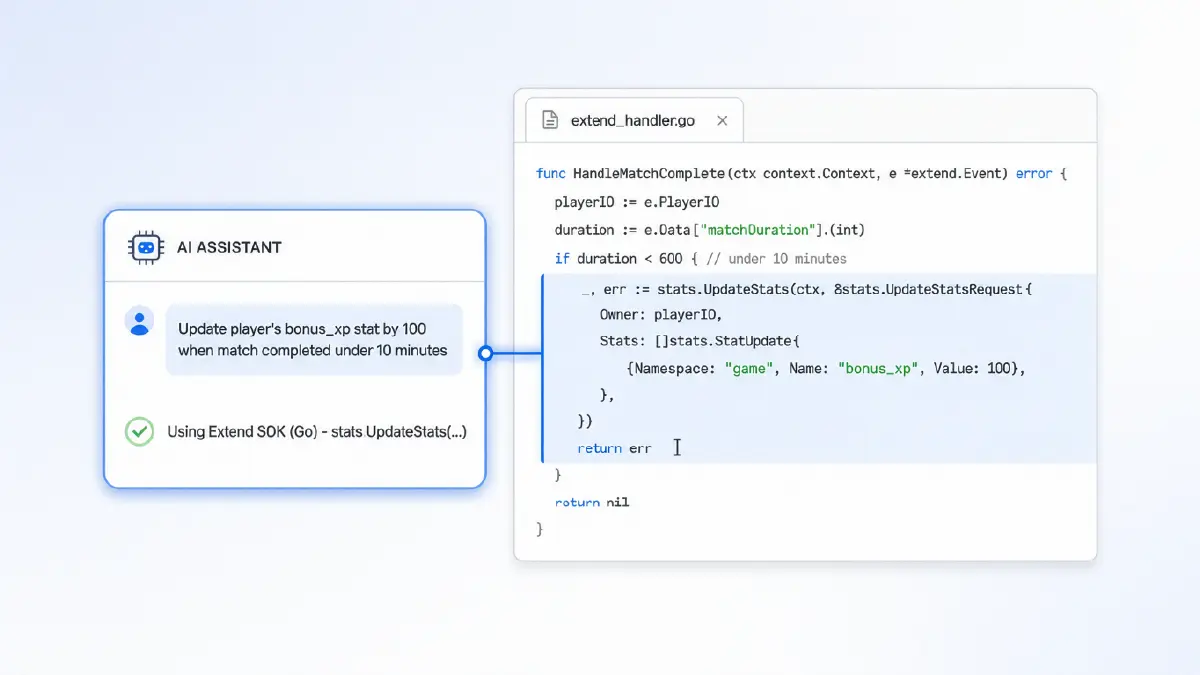
AGS Extend SDK MCP Server gives your AI accurate, live knowledge of the AccelByte Extend SDK. When you're writing a custom event handler, service override, or any Extend app, the server exposes the full symbol space across Go, C#, Java, and Python: functions, models, parameter types, template structures. The AI uses the actual signatures instead of guessing at them.
Developers can connect both the MCP servers to their AI coding assistant of choice with a single JSON config file:
{
"mcpServers": {
"ags-api": { "type": "http", "url": "prod.gamingservices.accelbyte.io/mcp" },
"extend-sdk-mcp-server": {
"command": "docker",
"args": ["run", "-i", "--rm", "-e", "CONFIG_DIR", "ghcr.io/accelbyte/ags-extend-sdk-mcp-server:2026.2.0"],
"env": { "CONFIG_DIR": "config/go" }
}
}
}
Read this blog for a deeper look at how to structure your workflow around MCP servers, and how to actually use AI and MCP servers for game backend development.
AccelByte also ships CodeGen, our own tooling that generates working SDK clients from the same OpenAPI specs we use internally. Combined with MCP context, CodeGen means full SDK support for a new or custom engine can be done in days rather than months. For studios migrating to AccelByte from a different backend, it significantly compresses the timeline.
No other game backend provider currently ships MCP servers or something like CodeGen that connect AI coding assistants to their backend services. Every other provider requires developers to write integration code manually, and if they use AI to help, that AI is working blind.
What This Looks Like in Practice
A developer wants to build a custom Extend app that awards bonus XP to players who finish a match within a time window.
Without MCP servers:
open the API docs > find the right stats endpoint > cross-reference Extend SDK docs for the correct interface and types > write the Go code, and hope it matches what the service expects. That's an hour or two before any real logic gets written.
With both MCP servers connected:
-
Find the right endpoint.
Ask the AI to search for AGS endpoints that handle player statistics updates after a match. The AGS API MCP Server scans the OpenAPI specs and returns the exact endpoint, HTTP method, headers, payload schema, and auth requirements. No guessing. -
Write the event handler.
Ask the AI to write a Go Extend event handler that listens for an achievement unlocked events and calls the stats endpoint to apply a bonus XP modifier. The Extend SDK MCP Server finds the correct interface, the right model types for the match completion payload, and the exact function signatures. The AI writes Go code with correct imports, types, and gRPC structure from the first attempt. -
Test before deploying.
Ask the AI to create, upload, and deploy the app. The user also asks the AI to create a test user, verify that the user does not have any achievement nor stats. The user asks AI to use the AGS API MCP Server to grant the test user the achievement and also verify that the test user now has the stat.
This is all done in under 30 mins with AI doing almost all of the heavy lifting.
To show you exactly what this looks like, one of our engineers ran through this exact example from scratch. Watch the whole thing unedited from start to finish 👇
How We Use This Internally
These servers came from our own engineering workflows:
-
Extend app development.
Engineers on our Extend SDK team use the Extend SDK MCP Server with Cursor daily to build and test event handlers. Less time cross-referencing docs, more time on actual logic. -
API exploration.
Teams use the AGS API MCP Server to find endpoints, check payload shapes, and configure Extend apps without leaving their IDE. -
New engine support and migrations.
AccelByte CodeGen generates working API clients for any engine from our OpenAPI specs. With MCP context for the integration layer, full SDK support for a new engine now takes days instead of months. If your studio is on a custom engine or migrating from another backend, that timeline matters. -
LiveOps alerting.
Our alert pipeline connects the AGS API MCP Server to our monitoring flow. When an alert fires, an AI agent surfaces relevant data and suggests next steps automatically — helpful on single-engineer on-call shifts. -
SDK migrations.
We've used the servers to move game projects between major SDK versions. An AI agent feeds build errors back into itself iteratively until the project is clean, cutting what used to be days of manual work.
Get Started For Free During Development. Pay Only When Players Show Up.
AccelByte Gaming Services is free during development. No credit card, no clock ticking while you build. Includes access to all core AccelByte backend services, Extend and Multiplayer Servers.
✓ Trusted by studios of all sizes.✓ Production Ready from Day One.
✓ AI powered development.
You're almost signed up!
Verify your account by following the instructions sent to .
If you still haven't received an email, please check your spam folder.
Featured Blog Posts

Featured Customer Stories

Bring your first player online today.
Get started for free, and scale as your game grows.